Lettings & holiday lets
Serviced apartment turnover cleaning: step-by-step routines that avoid rushed turns
By SeaLight Shine14 min read
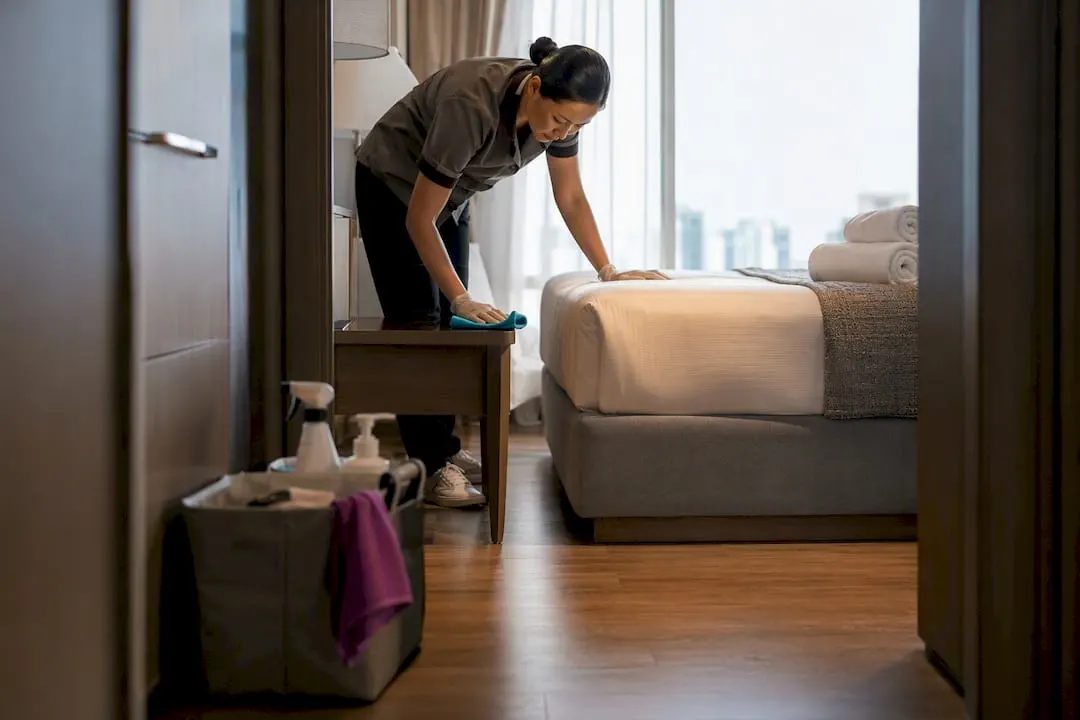
A correct serviced apartment turnover cleaning delivers a guest-ready property: every surface sanitised, linen changed, supplies restocked, and a final inspection signed off before the next arrival. Standard turnovers run 1 to 3 hours depending on property size, and the work should be verified against a checklist with photo evidence, not memory. Deep cleans sit outside this cycle entirely, scheduled every few months rather than after every stay.
TL;DR:
- Standard turnover cleaning takes 45 minutes to 3 hours depending on property size, with most tasks verified through photos and checklists, separate from deep cleaning.
- A room-by-room sequence starting with linen and ending with final inspection ensures efficiency and prevents re-dirtying surfaces during the process.
- Clear, written agreements covering fees, scheduling, and lost-property procedures reduce disputes and improve consistency across multiple properties.
- Deep cleaning should be scheduled every three to six months, using natural gaps to avoid disrupting regular turnovers, especially in high-turnover or pet-friendly properties.
- Using organized supplies, photo verification, and detailed SOPs helps maintain quality and streamline turnover efficiency, even at scale.
What does a standard serviced apartment turnover cleaning include?
A standard turnover is not a light tidy between guests. It is a fixed set of tasks that resets the property to the same standard every single time, regardless of who cleaned it last.
The core scope covers:
- Bathroom sanitisation: toilet, shower, bath, sink, mirrors, and all touchpoints disinfected, not just wiped.
- Kitchen deep-wipe: worktops, hob, sink, and a quick appliance check (fridge interior, microwave, kettle) for spills or leftover food.
- Linen and towel swap: beds stripped and remade, bath and kitchen linen replaced with a fresh set.
- Restocking: toiletries, tea and coffee, toilet roll, bin bags, and any welcome items topped up to par level.
- Waste removal: bins emptied and relined throughout, including outdoor or communal bin areas.
- Dusting and vacuuming: all rooms, including skirting boards, light fixtures, and under furniture where guests are likely to have dropped items.
- Staging: cushions plumped, curtains set, towels folded to a consistent hotel-style presentation before the door is locked.
A turnover clean is a top-to-bottom, room-by-room reset built around exactly this kind of scope, and it’s worth separating turnover tasks clearly from deep-clean tasks in your brief. Grout scrubbing, oven interiors, window tracks, and behind-appliance cleaning belong to the deep clean, not the turn. Blurring that line is one of the fastest ways to blow your turnover time budget and still leave guests unimpressed, because the finishing touches, straight photo frames, evenly folded towels, no visible vacuum lines, are what actually register on a guest’s first walk-through.
What’s the right order for a room-by-room turnover clean?
Sequence matters more than most hosts assume. Working top-to-bottom and back-to-front stops you from re-dirtying a surface you’ve just cleaned, and starting laundry immediately means it’s running in the background while you tackle everything else.
- Strip beds and start the wash the moment you walk in, so linen is cycling while you clean.
- Kitchen: appliances, worktops, sink, floor last.
- Bathrooms: sanitise from the top (mirrors, light fittings) down to the floor.
- Bedrooms: dust, remake beds, check under pillows and behind headboards for stray items.
- Living areas: surfaces, upholstery, remote controls (a notorious miss point), then floors.
- Outdoor space or balcony: sweep, check furniture, empty any outdoor bins.
- Final inspection: walk the whole property against your checklist before signing off.
A room-by-room checklist meaningfully cuts cleanliness complaints, and the same guidance flags a roughly 15-minute post-clean inspection as the point where most miss points get caught, things like remote controls, the inside of the microwave, and behind the toilet.
Pro Tip: Keep a laminated “miss list” taped inside the supply caddy: remote batteries, under the bed, inside the microwave, behind the sofa cushions. It takes seconds to check and catches most guest complaints before they happen.
Timing varies predictably by property size. Studios typically run 45 to 90 minutes, one-bedroom apartments 1.5 to 2.5 hours, two-bedrooms 2 to 3 hours, and three-bedroom properties 3 to 4 hours including the inspection buffer.
How much staff and time does a turnover actually need?
The turnover window is simple maths: the time between checkout and the next check-in, minus travel time to the property, minus the inspection buffer. Whatever’s left is your working budget, and it needs to comfortably fit the room-by-room timings above.
A two-person team roughly halves the clock time on larger properties, since one person can run the kitchen and bathrooms while the other handles bedrooms and living areas. On a studio or one-bedroom, a second cleaner often adds more coordination overhead than time saved.
- Same-day turns with under 3 hours available are workable for studios and one-beds with a practised team.
- Multi-bedroom same-day turns need either two cleaners or a rush fee to reflect the compressed schedule.
- When the workload clearly exceeds the checkout to check-in gap, block a buffer day rather than force it.
Pro Tip: If you’re regularly running the maths and coming up short, that’s a booking calendar problem, not a cleaning problem. Build a minimum-stay buffer between guests rather than pressuring your cleaning team into rushed turns, which is where quality slips and complaints start.
What should you budget for turnover cleaning?
Most hosts and property managers pay per turnover rather than by the hour, because a flat per-visit fee is predictable for both sides and easy to pass through to guests as a stated cleaning fee. Hourly billing makes sense mainly for irregular one-off jobs, not a recurring turnover schedule.
Pricing scales with property size and condition, and a handful of clauses are worth locking into any agreement upfront:
- Base turnover fee, scaled to bedroom count and typical clean time.
- Rush fee, applied when the turnover window is compressed below the normal working budget.
- Post-party or heavy-soiling fee, agreed in advance rather than negotiated after the fact.
- Notice period for schedule changes or cancellations.
- Access protocol: who holds keys or codes, and how access is logged.
- Linen responsibility: whether the cleaner supplies, launders, or simply swaps linen you provide.
- Dispute resolution: how a guest complaint about cleanliness gets investigated and resolved.
Property managers running multiple units benefit from formalising these terms in a written service agreement rather than relying on informal arrangements, and the same discipline applies to any contract covering cleaning services at scale.
When should you schedule a deep clean instead of a turnover?
A deep clean covers everything a turnover deliberately skips: oven interiors, extractor fans, grout lines, window tracks, behind and underneath furniture, mattress rotation, and descaling. It’s a different job with a different time budget, not an extended version of the standard turn.
Industry guidance recommends deep cleans every three to six months, with pet-friendly or consistently high-turnover properties sitting at the more frequent end of that range. The trick to keeping this from becoming a scheduling headache is using natural gaps, an off-season week, a booking cancellation, a maintenance visit, rather than trying to squeeze deep-clean tasks into a normal turnover window. Planning deep cleans around your holiday let cleaning frequency keeps standards consistent without disrupting your booking calendar.
Which tools and supplies keep turnovers fast and consistent?
The right kit matters less than having it organised the same way every time. A supply caddy stocked to a fixed par level, so a cleaner never has to guess what’s missing, saves more time than any single product choice.
- Microfibre cloths (colour-coded by room to prevent cross-contamination), a decent HEPA-filter vacuum, and a steam cleaner for upholstery and grout.
- Multi-surface disinfectant approved for the surfaces in the property, plus a dedicated limescale remover for bathrooms and kettles.
- A restock kit: toiletries, bin bags, tea and coffee sachets, toilet roll, held at fixed par levels and topped up on every visit.
On linen, the trade-off is straightforward: laundering on-site gives you full control but ties up washing machine time and adds staff hours; a linen swap programme costs more per turnover but removes laundry from your critical path entirely, which matters most on tight same-day turns.
How do you build quality control into every turnover?
A checklist without verification is just a wish list. The properties with the fewest guest complaints are the ones where every turnover produces evidence, not just a text saying “done”.
- Require photos for a short list of critical steps, bathroom, kitchen, and bed staging, timestamped automatically by whatever app or software you use.
- Run a 15-minute post-clean inspection, either by the cleaner themselves or a manager, before the property is marked ready.
- Keep a property card per unit with staging photos, linen inventory, and access details, which cuts onboarding time dramatically for new cleaners.
- Set a clear escalation process: who a cleaner contacts if something’s damaged, missing, or beyond scope.
Digital checklists with photo verification are now standard practice for hosts managing more than one or two properties, largely because they turn “the cleaner says it’s done” into something you can actually check. Hosts who require photos for a small set of critical items see fewer disputes and resolve the ones that do happen far faster.
Pro Tip: Don’t ask for photos of everything. Pick five or six genuinely high-risk points, bathroom, hob, bed, and make photo evidence non-negotiable only for those. Demanding forty photos per turnover just trains cleaners to rush the shots.
SeaLight Shine’s approach: templates that actually get used
A property card with staging photos, linen counts, and access notes only works if cleaners actually open it. Ours are built short and visual, one page per property, so a new cleaner can be productive on their first visit rather than their fifth. That single document is usually the difference between a five-minute handover and a half-day training session.
When you bring in a professional provider, expect a written scope of work, a room-by-room SOP, and photo verification on every job as standard, not as an upsell. That’s the baseline a reliable cleaning service should offer, whether it’s covering a single holiday let or a portfolio spread across several buildings.
What happens to items guests leave behind?
Lost property is a near-daily reality across any decent-sized short-let portfolio, and how it’s handled says a lot about how well a turnover process actually works.
The moment a cleaner spots a left item, phone charger, jewellery, medication, clothing, it needs to go through a fixed process rather than sitting in a drawer or a cleaner’s bag. That means: photograph the item where it was found, log it with the date, unit, and guest booking reference, then move it to a secure, centralised lost-property location rather than leaving it on-site. Items left in a property between guests create liability if a second guest finds them first, and they create confusion if a host can’t confirm which stay an item belongs to.
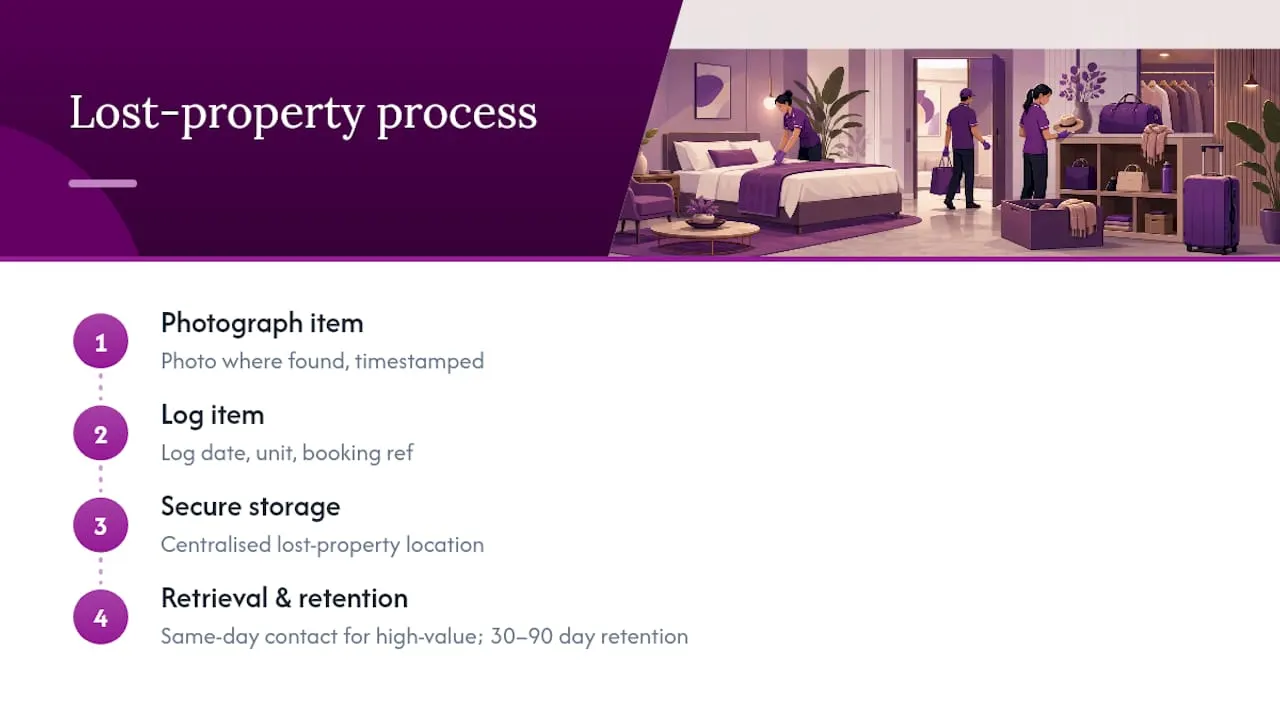
Set a retention window, most operators use somewhere between 30 and 90 days, after which unclaimed items are donated or disposed of, and put that policy in writing so guests know what to expect if they contact you. Higher-value items (passports, wallets, laptops) deserve a shorter, more urgent contact attempt, ideally the same day, since guests travelling home often need these back immediately.
Build this into your cleaner’s checklist as a discrete step, not an afterthought. A cleaner working to a tight turnover window will move fast, and lost-property handling is exactly the kind of task that gets skipped under time pressure unless it’s written into the SOP with the same weight as sanitising the bathroom. Logging it consistently also protects you: if a guest disputes what was or wasn’t left behind, a timestamped photo and log entry settles the question in seconds rather than becoming a lengthy back-and-forth.
How can turnover cleaning be more sustainable?
Eco-friendly turnover cleaning isn’t just a marketing line, it changes what goes in the supply caddy and how linen gets handled at scale. For property managers running several units, small changes compound quickly across dozens of turnovers a month.
Start with product choice. Concentrated, refillable cleaning products cut plastic waste substantially compared with single-use spray bottles bought new each time, and most perform just as well on standard bathroom and kitchen surfaces. Microfibre cloths, washed and reused rather than replaced with disposable wipes, are both cheaper over time and generate far less waste.
Linen and towel programmes carry a real environmental cost through water and energy use, so it’s worth training cleaners to change linen only when a guest has actually used it, rather than automatically swapping everything on every visit regardless of length of stay. Many hotel groups have shifted to guest-opt-in linen changes for exactly this reason, and the same logic applies to serviced apartments.
Restocking is another lever. Buying toiletries, tea, and coffee in bulk rather than individually wrapped miniatures cuts packaging waste and usually costs less per unit. Where possible, refillable dispensers for shower gel and shampoo remove single-use plastic bottles from the cycle entirely.
None of this requires compromising on the sanitisation standard guests expect. Disinfectant still needs to do its job on high-touch surfaces. The sustainable choices sit around that non-negotiable core: what packaging the products come in, how often linen gets changed, and how supplies get bought and stored.
What goes wrong most often in turnover cleaning?
Most turnover problems trace back to one of a handful of recurring issues, and they’re worth troubleshooting before they become guest complaints.
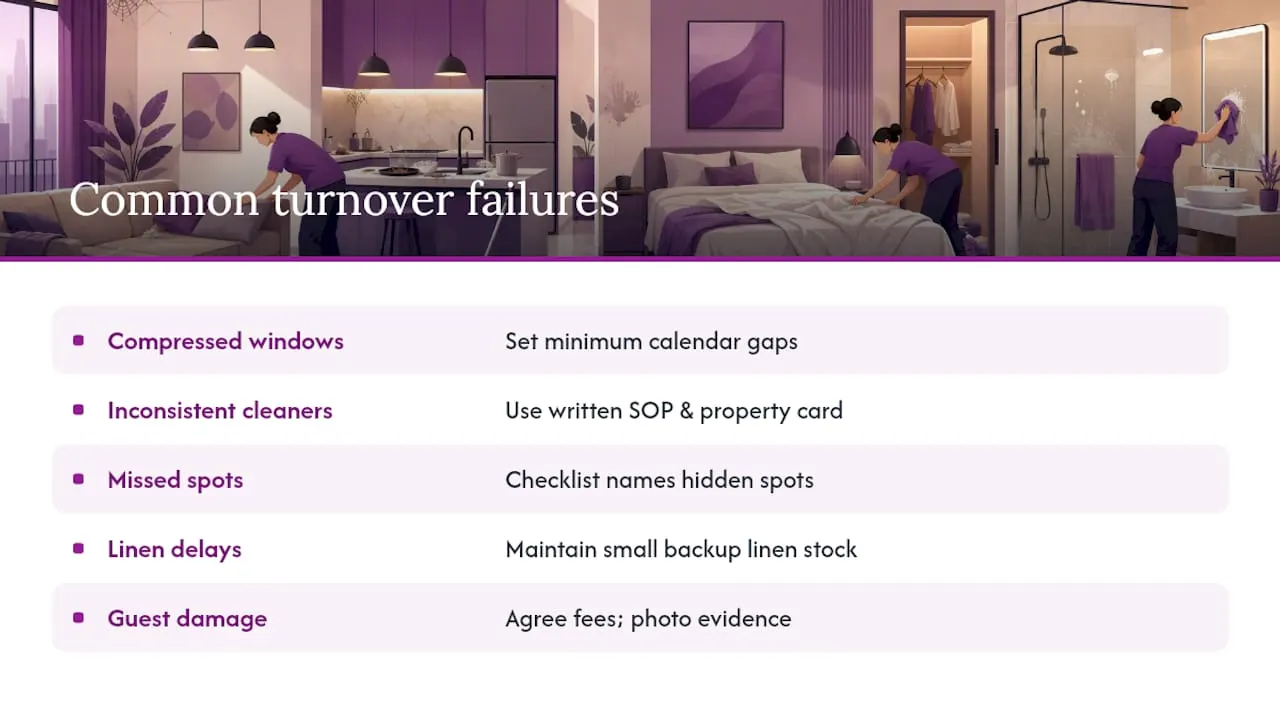
Compressed turnover windows are the biggest one. When back-to-back bookings leave less time than the job genuinely needs, quality drops even with a skilled cleaner, because something in the checklist gets rushed or skipped. The fix is calendar discipline: build minimum gaps between bookings that match your property’s realistic turnover time, not the shortest gap a guest might want.
Inconsistent cleaners cause the second most common issue. Different people interpret “clean the kitchen” differently unless they’re working from the same written checklist every time. A documented SOP and property card remove that variability almost entirely, which is exactly why they matter more as you add properties.
Missed items in awkward spots show up constantly in guest reviews, under beds, inside microwaves, behind toilets, remote controls. These aren’t hard to clean, they’re just easy to forget without a checklist that names them explicitly rather than relying on general instructions like “clean thoroughly.”
Linen delays disrupt more turnovers than most hosts expect, particularly when laundry is running on-site and something goes wrong with a machine or a delivery. A backup linen supply, even a small emergency stock, prevents a single failure from cancelling a check-in.
Guest-caused damage or excessive mess needs a clear process rather than ad hoc decisions each time. Agree post-party or heavy-soiling fees with your cleaning provider in advance, and document the condition with photos before charging a guest, so there’s no dispute about what actually happened.
Author’s perspective: scaling turnover cleaning from one property to a portfolio
DIY turnover cleaning works fine for one or two properties managed by a hands-on host. It stops scaling somewhere around the third or fourth unit, when scheduling clashes and missed details start costing more in guest complaints than a proper system would cost in fees.
The priority order for investment, in our view, is scheduling first, checklists second, photo verification third. A linen programme comes later, once volume justifies the added cost. Spend on guest experience where it’s visible, staging, linen quality, restocking, and keep the invisible admin as lean as a checklist allows.
Kate
Ready for a professional turnover clean? Here’s what to expect
A professional cleaning service for holiday lets, serviced apartments, and end-of-tenancy properties typically follows operational discipline similar to what this guide has covered: room-by-room SOPs, photo verification on key checkpoints, and a final inspection before any property is marked ready.
What sets a properly run turnover service apart isn’t the mop and bucket, it’s the paperwork behind it. Every job runs against a written checklist tailored to your property, not a generic template, and every cleaner works from the same property card so standards don’t slip when staff changes. That consistency is what helps maintain high guest satisfaction by avoiding issues like missed remote controls or stained pillowcases.
If you’re setting service expectations for the first time, our guide to what to agree before you book covers the same contract points raised earlier, notice periods, access, and linen responsibility, so you know exactly what to ask for. When you’re ready to move beyond routine turnovers, request a quote for deep cleaning and we’ll scope the job against your property size and turnover schedule directly.
Sources
- Vacation Rental Cleaning: Process, Costs, Checklists, and Tools (Hostfully)
- Vacation rental turnover cleaning checklist 2026 (Houfy)
- Vacation Rental Cleaning Checklist Template (2026) (Lodgify)
FAQ
Do serviced apartments include cleaning?
Most serviced apartments include a standard turnover clean between guest stays as part of the booking, covering sanitisation, linen change, and restocking, though deep cleans are typically scheduled separately rather than bundled into every stay.
What is the 20/10 rule for cleaning?
The 20/10 rule is a general productivity technique rather than a turnover-specific standard; professional turnover cleaning instead follows a fixed room-by-room checklist timed to the property size.
Is £20 an hour good rate for a cleaner?
Most professional turnover cleaning is priced per visit rather than hourly, since a flat per-turnover fee reflects the fixed scope of work more accurately than an hourly rate; ask any provider for a per-property quote rather than comparing hourly figures alone.
What is the 90 day rule for serviced accommodation?
The 90 day rule refers to a planning regulation in some areas limiting short-term letting without planning permission to 90 nights a year; it concerns letting rights, not cleaning standards, so check local planning rules separately from your turnover cleaning arrangements.
How long should a serviced apartment turnover cleaning take?
A standard turnover typically takes 45 minutes to 90 minutes for a studio and up to 3 to 4 hours for a three-bedroom property, including a short final inspection.